
















.jpg?la=en&h=320&w=720&hash=244C75B74F0F77521D56164450973BCD)














.jpg?la=en&h=310&w=720&hash=8D9823F26AA80B2B75C3E4B2E61770DC)


.jpg?la=en&h=320&w=719&hash=13CA7E4AA3E453809B6726B561F2F4DD)
.jpg?la=en&h=306&w=720&hash=F21A7CD3C49EFBF4D41F00691D09AEAC)

.png?la=en&h=320&w=720&hash=18CFCCD916C92D922F600511FABD775D)











Highlights
- Modern building automation systems (BAS) can reduce infrastructure and operating costs by up to 60% while improving reliability, resilience and comfort
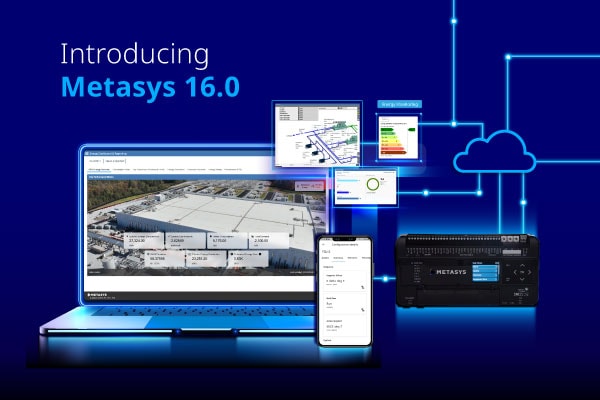
- Metasys – a modern BAS – acts as the brain of modern facilities by integrating security, fire, HVAC, lights and other systems into a single platform
- Metasys integrates with the experience of digital natives with a browser-based experience that makes complex data easier to manage
- At a recent event, the Johnson Controls team discussed how the organization and the Metasys BAS platform help building managers and owners maximize the environments in their facilities
This is the fourth in a series of podcast recordings on the future of intelligent facilities. Explore additional episodes, linked at the end of this article.
Innovation in the built environment is moving faster than ever. As organizations navigate trends such as high-efficiency chillers, electrification and decarbonization, another essential topic is often front and center: advanced building controls.
In a live podcast recorded at a recent event, ESCO Institute moderator Clifton Beck sat down with James Burke (Vice President of Product and Lifecycle Solutions at Johnson Controls) and JJ Plotz (Program Manager at Johnson Controls). They discussed how today’s building automation systems (BAS) – Metasys from Johnson Controls, specifically – are optimizing and redefining how people work in today’s facilities.
The need to connect all building systems continues to grow
As buildings grow more complex, building occupant expectations continue to rise. Facilities today must deliver comfort, efficiency, compliance, safety, resilience and sustainability – usually simultaneously. Meeting those demands requires more than best-in-class equipment; it requires a high level of intelligence across several systems including HVAC, Fire, Security, Life-safety systems and Lighting.
Metasys can connect thousands of controllers and data points to provide building operators with real-time visibility and data – whether those operators are on-site or remote.
"Metasys provides the right information at the right time so facility managers can take action,” said Burke.
By prioritizing meaningful alerts and reducing unnecessary noise, Metasys helps operations teams focus resources where they are needed most.
24/7 monitoring is the new norm
Building automation today represents a shift from simple monitoring to continual optimization. Platforms allow operators to visualize system performance, detect faults earlier, improve efficiency over time, spot trends and identify issues – even before they arise. In many cases, advanced control strategies supported by Metasys can reduce infrastructure and operating costs by up to 60 percent.
For Plotz, the true value of intelligent buildings lies in how all the systems work together. “Controls are the veins that run everything in a building together,” he stated.
From lighting and temperature to security and safety, optimization depends on coordination across the entire building ecosystem.
BAS provide a solution to the changing workforce demographic
The conversation also highlighted the changing nature of HVAC and Controls careers. Today's technicians and operators work at the intersection of mechanical systems and digital platforms, blending hands-on expertise with data, software and networking skills.
With many engineers and managers retiring without ready replacements, BAS can allow facility management teams to do more with fewer people. “That hybrid skill set is incredibly valuable – and incredibly resilient,” Burke noted.
Even as artificial intelligence plays a larger role in building management – and other facets of the modern world – physical building systems still require human insight and intervention.
Metasys and the continuing evolution of building automation
Metasys reflects an evolution through its intuitive, browser-based user experience designed for digital natives. However, it’s also easy to learn and implement for those who aren’t necessarily “natives.” Dashboards and workflows become familiar quickly to anyone who has used any sort of connected technology – including a mobile phone. This makes complex systems easier to navigate and understand.
Most importantly – as Burke and Plotz stated during the podcast – this work has purpose. Controls professionals touch hospitals, schools, data centers, stadiums, laboratories and much more – spaces where safety, comfort and performance have a direct effect on people’s lives. For the generation seeking a meaningful career, building automation provides a powerful way to make an impact. Metasys is a significant part of that.
Ready to explore real-world examples, personal insights and a deeper dive into Metasys?
Frequently asked questions
What is a building automation system?
A building automation system (BAS) is the technology that controls and monitors building systems – such as HVAC, lighting, energy management, security – to keep spaces safe and comfortable. BAS platforms use controllers, sensors and software to help automate routine operations and provide visibility into systems and equipment performance.
How is building automation changing Controls/HVAC careers?
Modern BAS roles combine mechanical, digital and analytical skills. They offer long-term job security and opportunities to work in diverse, mission-critical environments.
How does Metasys support smarter building operations?
Metasys provides real-time visibility, fault detection and intuitive dashboards. They enable faster decision-making, proactive maintenance and continuous optimization.
Does Metasys integrate with third-party systems?
Yes. Metasys is built on an open, standards-based architecture. It supports protocols such as BACnet, Modbus and LonWorks to seamlessly integrate third-party systems.