
















.jpg?la=en&h=320&w=720&hash=244C75B74F0F77521D56164450973BCD)














.jpg?la=en&h=310&w=720&hash=8D9823F26AA80B2B75C3E4B2E61770DC)


.jpg?la=en&h=320&w=719&hash=13CA7E4AA3E453809B6726B561F2F4DD)
.jpg?la=en&h=306&w=720&hash=F21A7CD3C49EFBF4D41F00691D09AEAC)

.png?la=en&h=320&w=720&hash=18CFCCD916C92D922F600511FABD775D)










Highlights
- Reliable Trades podcast host Adrian Garcia discusses his wide-ranging industry experience in this conversation, covering everything from intelligent buildings to predictive analytics to the importance of keeping ice cream frozen
- Automated navigation walks technicians through the processes step by step, helping them quickly identify issues and take action
- With a global installation base, Johnson Controls can scale and learn by region, to deliver comprehensive lifecycle services tailored to the needs of each customer
This is the third in a series of podcast recordings on the future of intelligent facilities. Explore additional episodes, linked at the end of this article.
In commercial buildings, transformation rarely starts with a dashboard. It starts at the edge, with the actuators, sensors and controllers that collect data and connect equipment to intelligence.
During a live podcast conversation recorded at a recent event, Adrian Garcia - host of the Reliable Trades podcast - sat down with Babak Haghayeghi (Global Product Management Director, Metasys) and Snita Menon (Product Management Director Field Devices) from Johnson Controls. Their discussion covered everything from how building controls and field devices have evolved to why those devices have become mission-critical to modern facilities.
Their message was clear: today’s facility performance, efficiency and resilience goals depend on how well buildings sense, interpret and act on data in real time.
From hardware to intelligence: the evolution of field devices
Field devices were once considered to be passive components. Today, they are intelligent and critical participants in the building ecosystem. They collect data, enable diagnostics and help facility managers to accelerate decision-making.
Beyond their traditional role in sensing and control, field devices today are becoming critical sources of operational intelligence. By continuously monitoring conditions including temperature, pressure, airflow and equipment performance, they help identify issues earlier, improve system visibility and provide that data foundation necessary for more proactive maintenance strategies. As buildings become increasingly connected, these devices are enabling faster troubleshooting, reducing manual effort and helping operators make more informed decisions, with greater confidence.
As expectations for building performance continue to evolve, one of the most important shifts highlighted in the conversation is how operators interact with building systems. In the past, diagnosing issues often required deep technical expertise, manual troubleshooting and time spent navigating complex documentation. Today, that paradigm has changed.
Building operators increasingly expect systems to identify issues and guide them toward resolution. As Babak explained, there is a growing expectation for systems to “tell me what is wrong and tell me how to take action effectively.” This can surface actionable insights without requiring extensive pre-work from technicians.
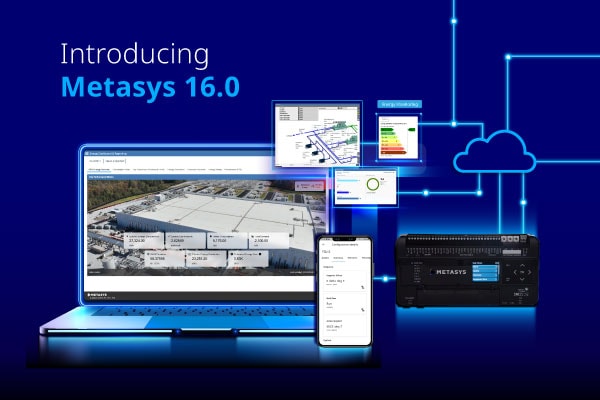
Rather than relying on static workflows or manual interpretation, modern systems are evolving to deliver guided, step-by-step processes tailored to the specific issue at hand. Within Metasys, this takes the form of built-in fault detection and triage. These features are supported by rule-based intelligence that allows technicians to easily understand what failed, why it failed and what to do next.
Putting operators first in a data-rich world with predictive diagnostics
Customers no longer want to simply fix equipment as it breaks. They want (and need) to avoid costly downtime in the first place. To meet the demand for uptime, Johnson Controls has shifted its focus to data-driven predictive diagnostics.
As building systems grow more capable, simplicity becomes critical. User-first design allows operators to translate data into action without added complexity. Babak noted “The Metasys platform gives you fault detection and triage – this is built in.”
This level of intelligence starts at the edge, with field devices. These devices generate high-quality, real-time data that power predictive diagnostics and enable guided workflows. As Snita explained, the focus is shifting toward more predictive operations where systems can signal potential failures before they impact occupants or operations.
This evolution is particularly impactful in addressing the industry-wide workforce shortage and skills gap. By embedding guided workflows within the platform, even less-experienced technicians can easily navigate complex systems. Babak noted, the goal is to “walk operators through it step by step” reduce the need to consult lengthy manuals and accelerate time to resolution.
Together, this combination of intelligent edge devices and operator-centric software is redefining what building intelligence looks like: more accessible, more proactive and more impactful across the building lifecycle.
Intelligence that scales with the building lifecycle
The true value of controls and field devices is realized over the life of the building, from commissioning and operations to optimization and modernization. With over 54,000 installations in buildings worldwide, Johnson Controls can learn from regulations in different countries, meet differing regional requirements and pivot accordingly to provide what customers need.
“Having diverse customer facilities all over the world creates opportunities for us to learn from those customers,” said Snita Menon.
Watch the complete podcast and explore more from the Johnson Controls intelligent buildings podcast series
FAQs
How are smart buildings impacting occupant health and comfort?
Today’s building system designs reflect how building environments affect occupant health and wellness. Specifications must meet evolving requirements for comfort and indoor air quality, which can affect a business’s bottom line. According to Lawrence Berkeley National Laboratory, productivity increases by approximately 1% for every 10% increase in air quality.
How is AI changing the way a BAS works?
AI helps buildings learn, adapt and self-optimize. AI can predict occupancy patterns, adjust HVAC parameters, detect equipment failures or pending failures, identify opportunities for energy savings and help facility teams make more effective decisions.