
















.jpg?la=en&h=320&w=720&hash=244C75B74F0F77521D56164450973BCD)














.jpg?la=en&h=310&w=720&hash=8D9823F26AA80B2B75C3E4B2E61770DC)


.jpg?la=en&h=320&w=719&hash=13CA7E4AA3E453809B6726B561F2F4DD)
.jpg?la=en&h=306&w=720&hash=F21A7CD3C49EFBF4D41F00691D09AEAC)

.png?la=en&h=320&w=720&hash=18CFCCD916C92D922F600511FABD775D)










Engineering the environments where giant leaps begin
For more than 140 years, Johnson Controls has helped shape history through innovation. In the 1960s, that meant enabling humanity’s first steps on the Moon. Our decades-long partnership with NASA is a powerful example of how our technologies have supported – world-changing missions – and how that same spirit continues to support today’s mission-critical environments.


Where progress takes flight
At the dawn of the Space Age, Johnson Controls York was at the forefront of technology. We were honored by NASA for its “mission control” instrumentation – a critical contribution to the Apollo and Saturn space programs – and we’re still engineering the environments where giant leaps begin.
Engineering brilliance at the edge of space
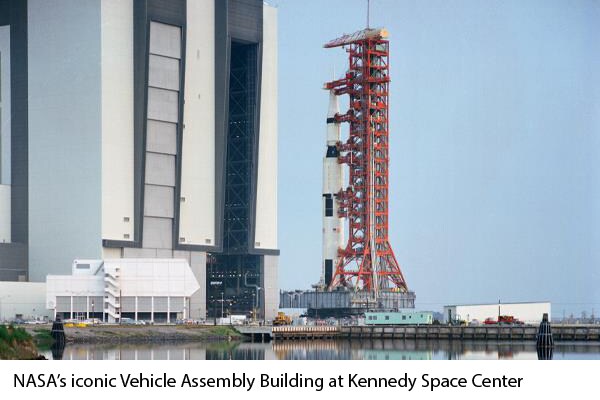
Back in 1965, the world sat up and took notice. Cooling the world’s largest building (by volume) was not easy. At the time, Contractor magazine reported: “US Moonport Takes 10,000-Ton Air Conditioning System.” This was no ordinary setup; it cooled the beating heart of the Vehicle Assembly Building (VAB) at Kennedy Space Center. The VAB was built and designed to stack the mighty Saturn V rockets that would propel Apollo astronauts toward the Moon. Inside the VAB, precision climate control was mission critical. Without it, condensation, corrosion and thermal expansion could compromise delicate components. Worst of all, the vast interior could even generate its own rain clouds, threatening to derail rocket assembly.
Enter Johnson Controls (known as Johnson Service Company and York Engineering at the time) - the unsung heroes behind a revolutionary solution. With four colossal 2,500-ton York Turbomaster chillers and our state-of-the-art pneumatic controls, a stable and controlled environment was created to safeguard the assembly process and ensure every Apollo launch reached for the stars. Innovation, vision and engineering mastery – it was a partnership that shaped history at the edge of space!
Mission-critical engineering behind the scenes
By 1969, our work extended beyond the launch pad. At Rockwell’s Downey, California clean room, spacecraft modules for the Apollo missions were undergoing final testing under strict environmental conditions.
NASA’s contractor, North American Rockwell, honored Johnson Controls for “Outstanding Achievement” for replacing the vital systems that supplied nitrogen, oxygen, helium and coolant fluids without interrupting the delicate preparations for Apollo 9. This was more than a job. It was a vote of confidence in the precision, innovation and trustworthiness that still defines Johnson Controls today.
NASA’s legacy – and ours
The moon landing didn’t just change where we could go – it changed what we could imagine and sparked a wave of engineering advances across industries. From memory foam to solar cells, from water purification to freeze-dried food, more than 2,000 spinoff technologies emerged from the space race (NASA Spinoff). Among them: smarter, safer building systems. Apollo-era challenges helped catalyze progress in sensors, automation and systems integration, laying the groundwork for modern building technologies. Companies like ours used these insights to evolve from pneumatic thermostats to today’s intelligent platforms.
The evolution continues
Johnson Controls continues to develop innovative solutions that set new standards. What began with climate control for a launchpad has grown into integrated, next-generation equipment, technology and services that unlock new levels of safety and building performance to create spaces that work better for everyone.
From Apollo to OpenBlue, our commitment is the same: engineer the environments where innovations happen and help every customer take their own giant leaps. Discover how Johnson Controls can help your organization take its own giant leap in smart buildings with our smart buildings kit.