











.jpg?la=en&h=320&w=720&hash=244C75B74F0F77521D56164450973BCD)










.jpg?la=en&h=310&w=720&hash=8D9823F26AA80B2B75C3E4B2E61770DC)

.jpg?la=en&h=320&w=719&hash=13CA7E4AA3E453809B6726B561F2F4DD)
.jpg?la=en&h=306&w=720&hash=F21A7CD3C49EFBF4D41F00691D09AEAC)

.png?la=en&h=320&w=720&hash=18CFCCD916C92D922F600511FABD775D)










Highlights
- Among organizations that have deployed AI, 42% of business leaders and 47% of FMs use it to enable predictive maintenance; the numbers are even higher for those who plan to implement AI in the next year
- Friction has emerged as technology scales: When asked what they would most like to change about their current workplace management system, 33% of business leaders cite ease of integration ‒ by far the top response
- Organizations are prioritizing space optimization: Among those that use workplace management technology, 75% use it for space management and planning, up from 70% last year
Over the course of 2025, many organizations underwent a critical shift in how they use technology to optimize their facilities. Early on, much of the conversation still centered on return-to-office (RTO), short-term operational decision-making and whether to go all-in on AI-powered technology tools. By the end of the year, the impetus behind RTO had faded and businesses had turned their attention to improving the productivity of their employees and the performance of their facilities and workplaces, with technology playing an increasing role. The results of the 2026 AI & Digitalization in Facilities Management Report capture some of the forces behind this shift and provide a glimpse at what comes next.
In December, we surveyed 760 U.S.-based business leaders across facilities, finance, HR, IT and real estate, as well as 260 U.S.-based facility managers (FMs), to gauge their views on issues including technology adoption, work arrangements and operational challenges. All respondents represented organizations with more than 200 employees.
Here are four top takeaways from the report:
1. The workplace conversation has evolved from attendance to performance
While RTO dominated headlines early in the year, most organizations appear to have stabilized around models that balance flexibility and collaboration:
- 95% of employees are in the office at least three days per week
- 76% of business leaders say they’re satisfied with current attendance levels
- Only 8% want employees in the office more
With attendance largely normalized, priorities have shifted toward productivity, facility performance and optimization. Among organizations using workplace management technology:
- 75% use it for space management and planning (up from 70% last year)
- 56% planning a new deployment next year say they’re adopting space planning tools
- 40% say they plan to deploy an integrated workplace experience solution in the next year
But visibility gaps remain: nearly 1 in 4 business leaders still track attendance and utilization manually or not at all, and utilization ranks #2 among areas where leaders want better insight (48%), just behind cost (56%).
Explore the full findings in the 2026 AI & Digitalization in Facilities Management Report
2. AI adoption grows, but integration becomes the gatekeeper to value
Adoption of workplace management technology is now widespread: According to our 2025 survey, 85% of organizations use workplace management solutions. But as deployments expand, a new friction point has emerged: integration. Fragmented ecosystems limit scalability, slow decision-making and cap the return on digital investments.
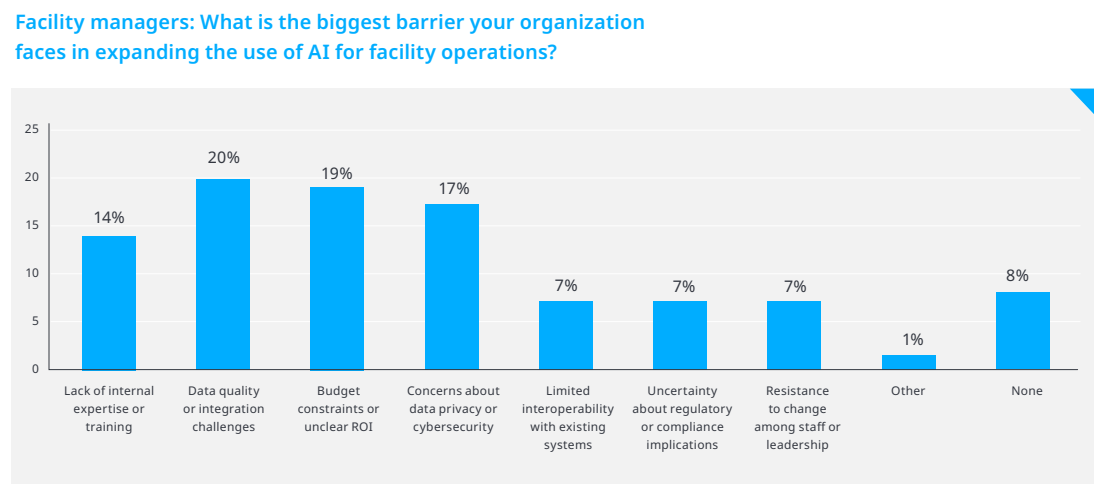
When asked what they would most like to change about their current workplace management system, one-third of business leaders cite ease of integration — by far the top response. Meanwhile, for FMs, data quality and integration issues are the biggest barriers to scaling AI, surpassing budget constraints, cybersecurity concerns and lack of expertise.
Despite these concerns, adoption is high and growing:
- 65% of business leaders and 67% of FMs say their organization is already using AI to improve the operation, utilization and maintenance of their facilities
- 65% of business leaders and 61% of FMs plan to implement AI tools or expand their use over the next year
3. Practical operational pressures are shaping technology priorities
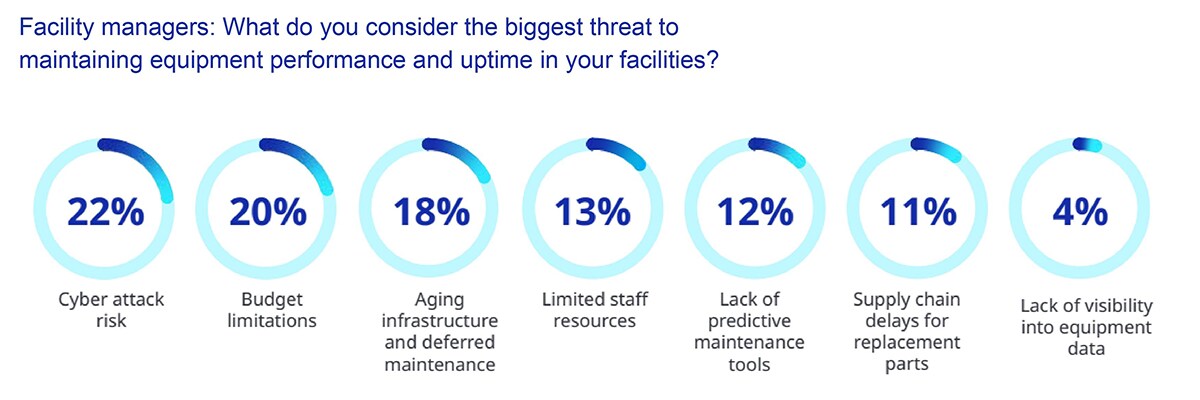
Facility managers are operating under growing pressure to do more with fewer resources as rising energy costs, budget constraints, labor shortages and cyber risks converge. But among all threats to equipment performance and uptime, FMs cite cyberattack risk as the most significant:
- Cyberattack risk: 22%
- Budget limitations: 20%
- Aging infrastructure: 18%
At the same time, 72% of FM respondents say labor shortages have a moderate to severe impact on operations, and more than 19% cite budget constraints as their top challenge to managing facilities effectively – the top response.
4. AI-driven predictive maintenance leads tech investments for 2026
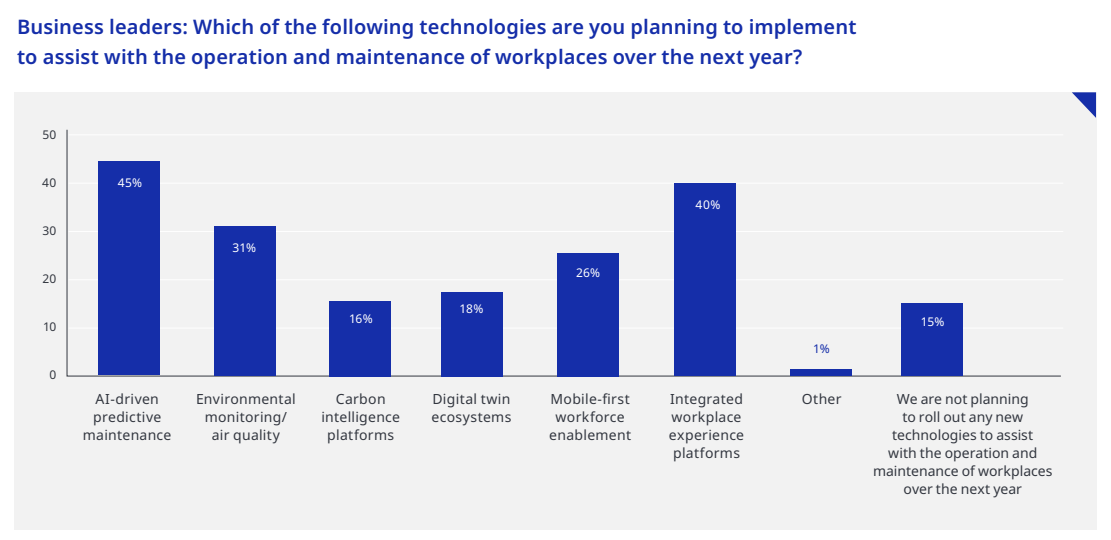
As organizations move from experimentation to execution in their implementation of facility performance and optimization technology, business leaders and FMs are prioritizing solutions that improve reliability, uptime and operational performance. Across both groups, AI-driven predictive maintenance emerges as the top planned investment, signaling a shift toward proactive, performance-driven operations.
- Among organizations that have already deployed AI to improve the operation, utilization and maintenance of their workplaces and facilities, 42% of business leaders and 47% of FMs use it to enable predictive maintenance.
- Among organizations planning to implement AI in the next year, 47% of business leaders and 52% of FMs are adopting a solution to enable predictive maintenance.
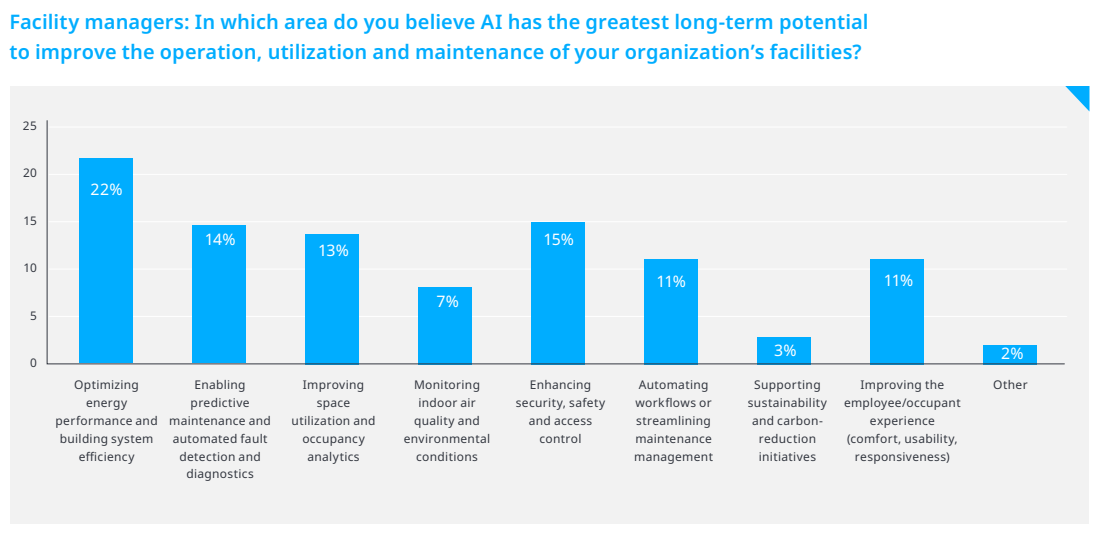
When asked where AI holds the greatest long-term potential, enabling predictive maintenance is both groups’ third-most popular response (14% for FMs, 15% for business leaders). Other top areas for potential, according to business leaders, are automating workflows or streamlining maintenance management (18%) and enhancing security, safety and access control (17%). For FMs, it’s optimizing energy performance (22%) and enhancing security (15%).
Looking ahead
The 2026 AI & Digitalization in Facilities Management Report shows organizations entering a new phase of performance-driven operations where AI adoption is widespread and growing and digital tools are no longer optional.
The next differentiators will be:
- Integration across systems
- Reliable, secure data foundations
- Solutions that deliver measurable operational and financial impact
For organizations focused on growth and resilience, facilities are no longer just places where work happens — they’re becoming active contributors to business performance. They are workplaces, hospitals, airports, classrooms and advanced manufacturing plants that perform optimally while creating value in business outcomes and bringing out the best in their occupants.