











.jpg?la=en&h=320&w=720&hash=244C75B74F0F77521D56164450973BCD)








.jpg?la=en&h=310&w=720&hash=8D9823F26AA80B2B75C3E4B2E61770DC)


.jpg?la=en&h=320&w=719&hash=13CA7E4AA3E453809B6726B561F2F4DD)
.jpg?la=en&h=306&w=720&hash=F21A7CD3C49EFBF4D41F00691D09AEAC)

.png?la=en&h=320&w=720&hash=18CFCCD916C92D922F600511FABD775D)




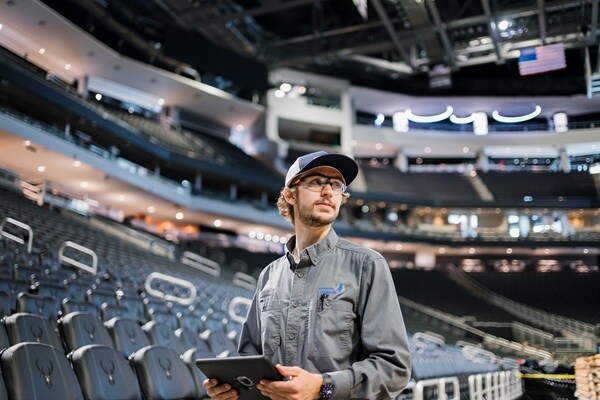






In 2025, work arrangements stabilized, the deployment of Internet of Things (IoT) devices accelerated, and the adoption of AI in buildings matured from pilot projects to mainstream investment. Meanwhile, sustainability and cybersecurity pressures intensified, driving more and more organizations to evaluate how facility performance and optimization solutions can improve efficiency and reduce risk. These dynamics made 2025 both exciting and challenging. So, what should organizations expect in 2026 when it comes to technology’s role in facilities management, space planning and real estate portfolio optimization?
Recently, Johnson Controls OpenBlue leaders Jennifer Heath, Senior Manager Product Marketing and Julius Marchwicki, VP & GM, Digital SaaS led a webinar to share their predictions for what the next year holds for facilities and real estate teams. Their insights point toward a future where buildings operate not just as cost centers but as strategic assets and drivers of growth – and where open, connected platforms like Johnson Controls OpenBlue help maximize the potential of that transformation.
Here’s a look at five of their predictions for what lies ahead in 2026:
Prediction 1: Top priorities will shift from attendance to optimization
With the normalization of work arrangements, organizations are no longer focused on implementing and enforcing attendance policies; instead, they’re figuring out how to improve productivity and efficiency. Leaders now see physical workplaces not as static cost centers but as dynamic environments that should be adaptable to business needs and occupant behaviors.
“This black-and-white choice of fully hybrid or fully in-office, I don’t think we’re going to have that conversation much anymore,” said Heath. “Instead, we’re going to have conversations about leveraging technology to make the most of our spaces and evolving them to better suit hybrid workers, to optimize them and maximize their potential.”
In 2026, organizations will invest more attention in analyzing how space supports outcomes, whether that be productivity, collaboration, customer-facing work, patient care or student experience. Workplace planning and management solutions like OpenBlue Workplace and OpenBlue Insights will give leaders enhanced visibility into utilization trends, environmental performance and occupant behaviors. This data will empower them to right-size portfolios and align physical assets with strategic priorities based on real usage rather than assumptions.
Prediction 2: AI will accelerate decision-making and operational optimization
Over the past couple of years, AI has become a familiar tool in commercial real estate and facility operations, but most applications have focused on simplifying access to information. Meanwhile, the volume of data coming off connected equipment and IoT sensors has climbed exponentially, putting pressure on teams whose tools and staffing levels weren’t designed to ingest or interpret data at scale. Leaders are recognizing that the real challenge isn't data collection; it’s acting on that data meaningfully.In 2026, the focus of AI applications will shift from providing insights to supporting and automating operational decisions. Agentic AI will help synthesize millions of data points across occupancy trends, sensor signals and external conditions to optimize controls dynamically. Rather than running buildings as if every day is the same, AI-enabled platforms will begin responding in real time to forecast demand, changing weather or unexpected events. Human operators will remain in the loop, but AI-assisted decision-making will improve efficiency, reduce waste and accelerate time to value – especially across large portfolios with distributed assets.
“AI is very good at collecting and aggregating millions and millions of data points produced at millisecond intervals, and it’s being wrapped into solutions for the market that will enable us to automate the way our facilities operate,” said Heath. “It's going to say, listen, the snowstorm is coming, no one's going to be showing up, let’s turn down the lights and heat to save some energy, emissions and expense.”
As AI takes on a larger share of operational analysis and decision support, organizations will seek platforms like OpenBlue that are capable not only of scaling to thousands of connected devices but aligning intelligent building responses with business, sustainability and resilience objectives.
Prediction 3: Sustainability will make the leap from compliance issue to growth catalyst
Sustainability efforts have historically centered on regulatory compliance or social responsibility. But rising energy prices, carbon reporting expectations and stakeholder scrutiny are reframing sustainability as an operational imperative.In 2026, organizations will shift from discrete sustainability initiatives to integrated decarbonization strategies linked to business value. We’ll see energy optimization, electrification planning and emissions tracking become essential capabilities, supported by unified platforms like OpenBlue.
“Most organizations have had this regulatory-driven, top-down approach to sustainability,” said Marchwicki. “But what businesses have started to realize is that every dollar saved by reducing energy waste is a dollar that can be invested in growth.”
Organizations can also preserve capital for growth by reducing exposure to carbon emissions taxes. Facility performance and optimization platforms like OpenBlue Net Zero and OpenBlue Central Utility Plant Optimization support this effort by providing the data and insights needed to drive efficiencies in energy management, which can reduce carbon emissions.
IoT sensors and utilization analysis will also support carbon reduction efforts by informing space management decisions. “When we talk about improving our spaces, that involves decisions around renovations versus retrofits versus new construction,” said Heath. “There are varying levels of emissions associated with each of those options, so it’s important to have the utilization data to support whatever decision you make.”
More data to support better decision making does come with a potential downside, however. As sustainability and automation scale, organizational exposure to cybersecurity threats expands. That will be another area of intense focus for organizations in the coming year.
Maximize your portfolio’s potential in 2026
Prediction 4: Facilities and IT teams will team up to tackle cybersecurity
Rapid expansion of connected devices over the past year has the potential to increase vulnerability to cyberattacks. Historically, operational technology (OT) systems like HVAC or access control were isolated from IT networks, but IoT adoption has erased that boundary, meaning that facilities leaders are now faced with accountability for cyber risk.
“You're going to see increasing collaboration between facilities and IT,” said Heath. “We're at this crossroads now where we have to bring these two knowledge sets together.”
Over the coming year, expect organizations to shift from bolt-on cybersecurity measures to proactive, integrated security strategies rooted in zero-trust, standardized protocols and continuous monitoring. Platforms like OpenBlue that integrate OT + IT visibility will be prioritized, and cybersecurity requirements will impact procurement, compliance and lifecycle planning.
“When you think about mission critical spaces like hospitals and airports, it becomes incredibly important to secure that technology,” said Marchwicki. “Facility managers have to make sure they’re not just relying, for example, on our IT teams to have a position about how to protect equipment. They will start leveraging AI tools to help with threat prediction. We're going to see a lot more of that as these threat actors get more and more aggressive."
Prediction 5: Open standards and interoperability will become foundational requirements
In 2025, the number of connected systems and smart building devices continued to surge across large portfolios. But this rapid expansion also highlighted a persistent stumbling block: most organizations operate complex mixes of legacy systems, proprietary controls and siloed data across dozens or even hundreds of buildings. Logging into multiple platforms, aggregating data manually or reconciling incompatible systems slowed progress, limited ROI and increased cyber risk. Conversations about interoperability gained momentum, but practical implementation lagged behind.
In 2026, interoperability will shift from aspiration to expectation. As more building systems become AI-enabled and data volumes grow, organizations will demand platforms built on open standards that unify data across regions, facilities, and equipment types. AI will play a critical role by rationalizing signals from disparate sources into actionable insights presented through a single interface. The value of connected buildings will depend less on individual devices and more on how seamlessly ecosystems communicate.
“Companies with large, distributed portfolios face a huge challenge in terms of being able to rationalize all of the data coming from these buildings in a way that makes sense,” said Marchwicki. “Everyone wants a single solution to solve their problems, and that requires interoperability and open standards to make all of those disparate systems work together. I see that coming together in 2026.”
As interoperability matures, it will amplify the benefits predicted earlier – fueling trust in AI-driven insights and enabling faster, more automated decision-making. Together, these forces will push smart buildings beyond incremental improvement toward portfolio-wide optimization grounded in shared data, unified controls and scalable intelligence.
Convergence will define 2026 and beyond
Taken together, these predictions point toward one overarching trend: convergence. AI maturity, sustainability as a growth driver, cybersecurity alignment and the pursuit of interoperability are no longer separate initiatives, but rather a single strategic transformation in how organizations operate, maintain and optimize their facilities.
As 2026 unfolds, the organizations that embrace convergence – and the platforms that make it possible – will unlock the next wave of value from their facilities: growth, resilience, and long-term competitive advantage.
“Throughout 2025, we’ve talked about utilizing data and AI to help drive outcomes. I think 2026 is the year where we’ll start to see the transformational organizational adoption of taking data from buildings and really using it to create a growth story,” said Marchwicki. “That’s my big aspiration for 2026."