


































Highlights
- AI acts as the brain of predictive maintenance, learning the normal performance baseline for assets and spotting degradation patterns that traditional rule-based systems could miss entirely
- AI-driven analytics within OpenBlue can detect chiller faults up to 48 hours in advance and failures with 82% accuracy
- A Las Vegas resort running OpenBlue Auto Mode and Metasys BAS across its central chilled water plant cut annual energy use by 10.2% and saved $110,000 in utility costs
- 76% of business leaders planned to implement generative AI for in operations and maintenance in 2025, up from 58% in 2024
AI-powered predictive maintenance helps facilities teams make better decisions by turning building data into actionable insights. It uses machine learning and IoT (Internet of Things) sensor data to track historical and real-time asset performance, turning large volumes of data into accurate risk assessments. AI-powered predictive maintenance anticipates when issues are likely to occur. This is a vast improvement over simply reacting when a machine breaks down.
For decades, facility teams relied on scheduled maintenance and reactive repairs. Today, commercial building operators face mounting pressure to reduce costs, improve energy performance, extend asset life and do more with limited maintenance resources. AI-powered predictive maintenance is emerging as a practical way to address all four challenges simultaneously.
Improve asset reliability, energy performance and operational efficiency
How AI enhances predictive maintenance in commercial facilities
AI functions as the brain of the predictive maintenance operation. It processes data from every system and generates insights that were previously difficult to identify. From the moment data is collected to the moment a technician completes a work order, AI collects and analyzes data. It’s the continuity, capacity and the ability to spot the most subtle patterns that make AI analytics valuable for facility managers.
Continuous equipment monitoring and pattern recognition
Over time, AI learns what normal operating behavior looks like for each asset across a building or portfolio. Once the baseline is established, it can detect when performance begins to drift, even if the change is gradual or subtle. AI uses advanced pattern recognition to fill in the gaps that traditional systems might have missed.
Failure forecasting and risk prioritization
AI helps facility teams understand how equipment health is changing over time. This gives them more opportunities to prevent disruptions, extend asset life and optimize maintenance resources.
For example, AI-driven analytics within OpenBlue can detect chiller faults up to 48 hours in advance and failures with 82% accuracy. This allows service experts to then validate those insights and coordinate responses.
Prioritization is another way that AI helps with maintenance workflows. The system can assign risk levels based on operational impact. This includes how many occupants may be affected by an outage, or which asset is most critical. For teams that are working across large facility portfolios, this level of instant visibility is hugely valuable and helps prevent blind spots.
Intelligent workflow integration with CMMS and BAS
All this intelligence must go somewhere. And that’s where Computerized Maintenance Management Systems (CMMS) and Building Automation Systems (BAS) come in. The BAS executes automated adjustments while the CMMS captures the resulting work orders and closes the loop. AI-generated insights inform work orders and provide context along with recommended actions.
After work is completed, maintenance records are fed back into the CMMS. When completion data is captured consistently, maintenance history can provide context for future analysis and help teams refine maintenance rules and workflows over time.
There are many real-world examples of this working in practice. A London financial center needed its seven business-critical chillers to always operate efficiently. However, routine on-site inspections failed to consistently detect deviations.
AI-powered diagnostics within OpenBlue found one chiller running 5°C hotter than it should in the condenser water temperature. One simple control adjustment made chiller operations 12–15% more efficient and reduced emissions by more than 30 metric tons annually.
This one example demonstrates how modern BAS platforms do more than supply data. Instead, they serve as the operational foundation for AI-driven maintenance strategies by continuously monitoring equipment, executing automated control adjustments and validating performance improvements after corrective actions are taken.
OpenBlue Services can improve your workflow efficiency
Technologies that power AI predictive maintenance
The most accurate way to understand AI predictive maintenance is as a stack of tools, each with its own distinct role, ranging from raw data collection to maintenance prompts. Below are examples of these stages and how they work together in practice.
Machine learning and time-series analytics
Machine learning models analyze time-series equipment data to detect degradation patterns that may otherwise go unnoticed. By tracking changes in performance over time and correlating them with other data sources, AI builds an ever-evolving view of facility health.
Even small changes that wouldn't trigger traditional alarms can become meaningful when analyzed longitudinally. In large commercial HVAC environments, advanced fault-detection models have demonstrated high accuracy rates alongside measurable reductions in maintenance costs.
The accuracy of these models is well documented. Recent research in a large commercial HVAC environment has shown fault-detection accuracy exceeding 96%, alongside measurable reductions in maintenance costs. Adoption and capacity will only accelerate.
IoT sensors, BAS data and edge computing
AI predictive maintenance uses high-quality data from IoT sensors and BAS, which collect real-time equipment data. Edge computing processes equipment data close to the source. This supports faster analysis and – when systems are configured for it – faster alerts, control responses or maintenance workflows.
Digital twins add another layer by creating virtual replicas of building assets. This allows for simulation and remote maintenance decisions using real-time IoT and BAS data. To support reliable data flow between all building systems and maximize effectiveness, it’s important to integrate legacy building data with modern IoT and AI-driven platforms.
Cloud analytics and portfolio-level intelligence
For large organizations, the strategic value of AI comes in consolidating data across the portfolio. Cloud-based analytics platforms bring all sites and assets into a single view and help standardize how performance is measured.
Johnson Controls worked with one of India’s largest industrial real estate portfolios. The project demonstrated the value of consolidating data across the portfolio. By adopting OpenBlue across 13 sites, the organization replaced manual data collection with a consolidated cloud-based view. This solution led to $10,000 in annual savings and improved operational productivity by 20%.
Real-world applications in commercial buildings
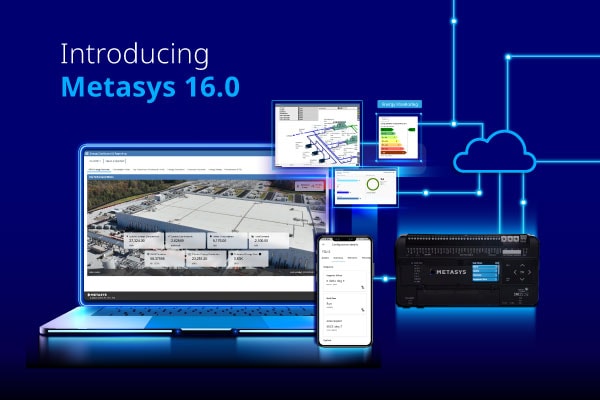
A Las Vegas resort was running its central chilled-water plant manually and around the clock. Johnson Controls replaced the legacy BAS system with OpenBlue Central Utility Plant Optimization – an AI-driven supervisory control software that predicts chilled-water loads and optimizes equipment combinations every 15 minutes – alongside Metasys, a streamlined, reliable automation system for real-time visibility and control.
The system now runs in AI Auto Mode more than 90% of the year. As a result, the resort achieved a 10.2% reduction in annual energy use and $110,000 in utility cost savings.
See how reliable automation can streamline your systems
Operational benefits for facility and portfolio leaders
The case for adopting AI predictive maintenance includes:
- Earlier intervention windows
- More efficient use of maintenance teams
- Buildings that perform better, longer
The most immediate benefit for facility and portfolio leaders is saving time. When AI detects a deviation, facilities teams can schedule repairs during planned windows and deploy technicians without an emergency premium.
The London financial center – mentioned above – illustrates this perfectly: a chiller running at a higher temperature had gone undetected until OpenBlue AI-powered diagnostics caught it. From there, a simple setpoint adjustment improved chiller operations by 12–15%.
Early intervention helps organizations reduce emergency repairs, improve technician productivity and avoid costs associated with unplanned downtime. Technicians can work from a proactive, prioritized list rather than reacting to emergencies and alarms. Added to this, facilities teams are not held responsible for scheduled maintenance checks or piles of paperwork. This can help teams work more efficiently, benefiting the entire business with less downtime.
Broader AI adoption in operations and maintenance is also accelerating. In a 2025 survey of 750 business leaders, 76% said they planned to implement generative AI for operations and maintenance, up from 58% the year before.
Snita Menon, Director Product Management T4 Controls and PENN at Johnson Controls, sees AI moving beyond insight toward autonomous action. AI will analyze millions of data points across occupancy, IoT sensors and external conditions – such as weather – to optimize like never before.
"It's going to say, listen, the snowstorm is coming, no one's going to be showing up – let's turn down the lights and heat to save some energy, emissions and expense."
Implementation considerations for enterprise facilities
Before moving to AI-driven predictive maintenance, it’s important to assess your organization’s AI readiness. This assessment is carried out to avoid stalled pilots, which often result from gaps that could have been addressed earlier. While not every gap needs to be resolved before launch, having a clear roadmap for each helps to deliver overall value at a faster rate.
Considerations to address before launch:
- Data quality: Poor data quality and standards can undermine the entire system and user confidence. Establish clear data structures, a consistent asset registry and standardized naming conventions. This should be applied retrospectively to historical data. Inconsistent or missing data reduces accuracy and undermines trust in the system.
- Legacy BAS integration: AI-driven predictive maintenance relies on clean, reliable data flowing from the BAS into the OpenBlue/BEMS intelligence layer above it. The key integration challenge is ensuring that the connection – between the BAS and the intelligence layer – delivers consistent, high-quality data feeds that the AI can act on, flowing from existing building systems. Older BAS will need to be integrated or migrated to ensure clean data flow. Please note that integrating systems retroactively can be disruptive.
- CMMS integration: Predictive models can forecast failures but it is the CMMS that turns insight into action by automatically generating work orders
- T-facilities collaboration: AI predictive maintenance sits at the cross-section of IT and operations. IT and facilities teams need to collaborate and establish shared ownership to be truly successful.
Considerations that can be addressed down the line:
- Sensor coverage: It’s normal to have gaps in IoT sensor coverage – especially alongside legacy systems. AI predictive maintenance can still be valuable, but the more coverage you can achieve, the better the results. Start by prioritizing the most critical assets or locations.
- Change management: Facilities teams require knowledge and context to adjust to new systems. Teams will require training in new systems to understand what the underlying data means and how prioritization works. Consider phased onboarding or specialist new hires to help with adoption.
- KPI alignment: Setting clear KPIs before pilots or initial launches is vital. KPIs create cross-functional accountability and provide evidence to justify broader rollout.
Enhance your building operations with AI
AI predictive maintenance is the operational intelligence layer that strengthens the existing maintenance strategy. It unlocks the right data, at the right time, so that teams can prioritize effectively. With AI predictive maintenance in place, maintenance efforts can be truly proactive, reducing the risk of failures and ensuring assets are run efficiently.
Strategically, this type of predictive maintenance offers significant benefits to facilities leaders. This includes lower operating costs, better energy performance and greater opportunity to scale. The technology is here, with proven results. For facility leaders, the next step is to identify where reliable data, critical assets and clear performance goals can create the strongest starting point.
Ready to learn more about AI-powered predictive maintenance?
FAQs
-
Can AI be used for predictive maintenance?
-
How does AI improve predictive maintenance?
-
What AI technologies are used for predictive maintenance?